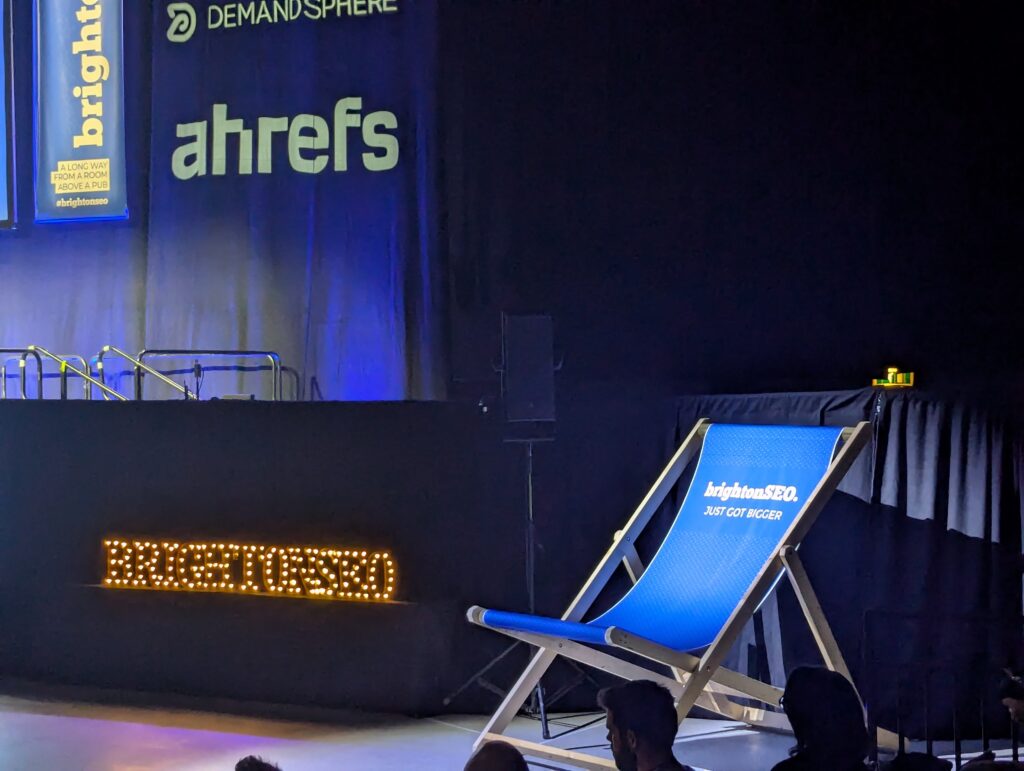
I headed down to Brighton on Friday, 1st of May, for the Spring 2026 edition of BrightonSEO, a global event series for SEOs and digital marketers, with flagship conferences in the UK and US. Compared to last year, the conversation has clearly moved on.
Twelve months ago, AI in search felt like something on the horizon. This time, it was everywhere. Not as a theory, but as something already shaping how people find businesses, compare options, and make decisions.
Here’s what stood out and what we’re already discussing with clients at britweb.
AI isn’t coming for search. It’s already part of it.
One of the biggest shifts is the extent to which AI is now involved in the buying journey. In the 2020s, the rise of generative AI tools has led to new optimisation approaches for AI-based search, known as generative engine optimisation (GEO).
A few points that came up across different talks:
- AI tools like ChatGPT are now widely used when people research products or services, and features like AI overviews provide concise, AI-generated summaries in search results.
- Around 40% of people use AI at some point before buying
- Many users say they trust what these tools recommend
AI-powered search engines are also better at understanding complex user queries and supporting conversational, answer-driven experiences, making audience-centric content more important than ever.
At the same time, most website traffic still comes from traditional search, with organic traffic remaining a key metric. So it’s not a replacement. It’s an extra layer.
What’s happening in reality is this:
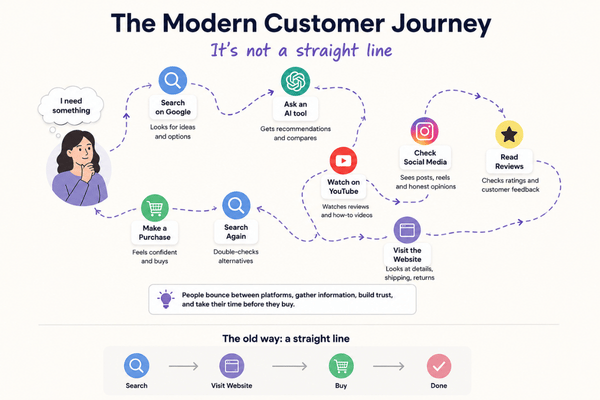
Someone might start with Google, check reviews, ask an AI tool for advice, watch a video, and then return to search to buy.
If your business isn’t showing up in those earlier steps, you’re missing opportunities before someone even reaches your website. Continuous monitoring of analytics is essential as search experiences change and evolve.
Think of AI like a digital shelf
One talk described AI search as an “invisible shelf”. That’s a useful way to think about it.
Your business doesn’t just appear there by chance. It shows up based on how clearly it’s described across the web.
What helps you get picked up:
- Clear, well-structured content on your own website
- Writing content that is compelling and useful
- Consistent product or service descriptions
- Good use of things like schema and page structure
- Optimising videos and images for search
- Using descriptive URLs that reflect the page content
But it doesn’t stop there.
AI also looks at:
- Reviews
- Retailers
- Social platforms
- Forums like Reddit
- Articles and editorial content
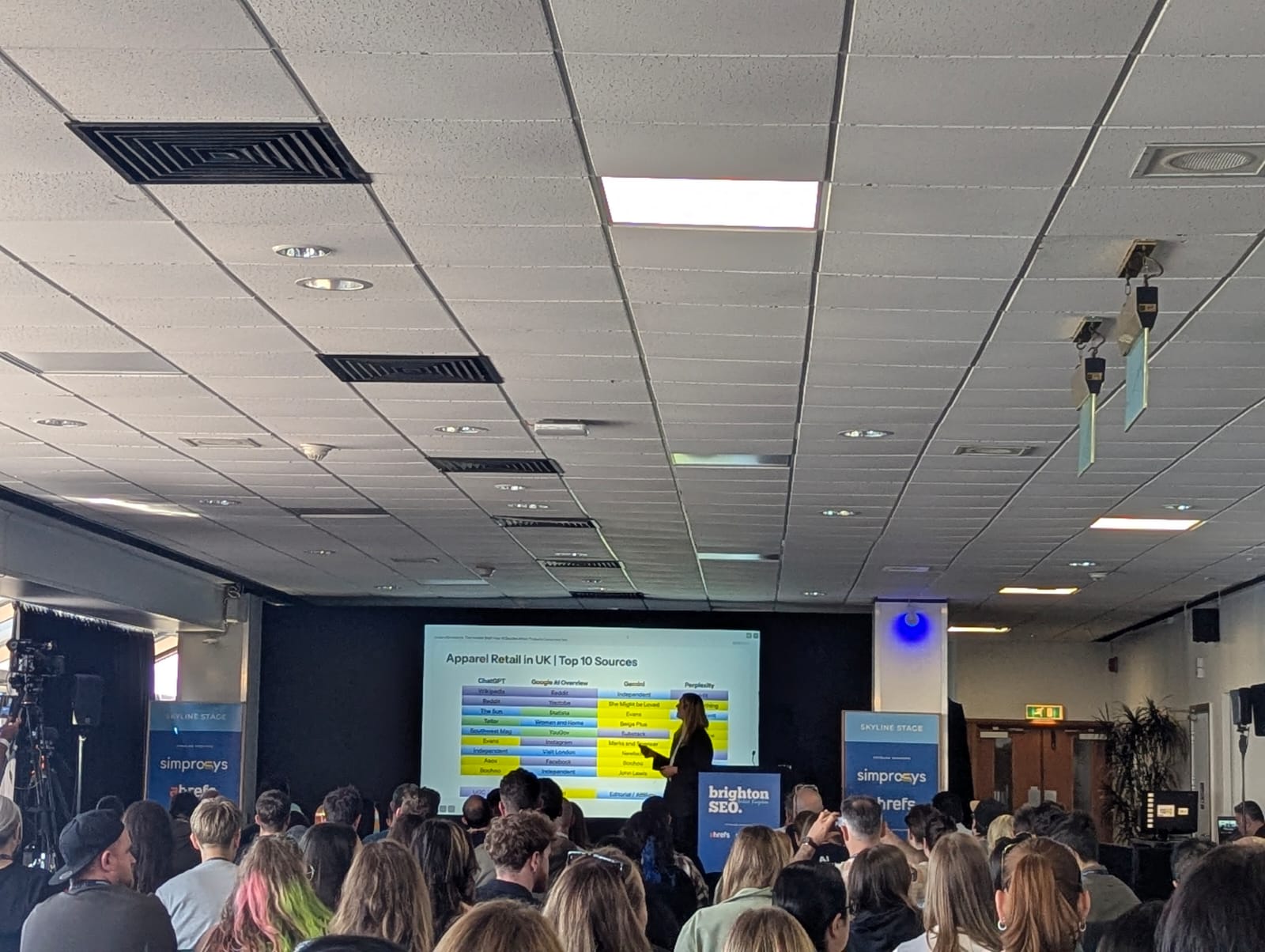
If all of those say similar things about your business, you’re far more likely to be included.
When structuring your content, remember that optimisation should be tailored to each given page based on its unique purpose and content.
It’s not just about ranking anymore
Search results pages have changed a lot.
You now have:
- AI-generated answers
- Featured snippets
- Extra search features
AI-powered search engines can now handle complex, multi-layered, and conversational queries, including follow-up questions, and provide more nuanced, context-aware results.
These often appear before the standard results.
So even if your site ranks well, it might not get seen.
That’s why the focus is shifting towards:
- How often does your brand appear in answers
- Where you appear
- How visible you are compared to competitors
It’s less about position, more about presence. Trust signals have become the primary differentiator in a market flooded with AI content, and E-E-A-T (Experience, Expertise, Authoritativeness, Trustworthiness) is paramount for search visibility. Building a brand that consumers genuinely trust is seen as an ‘algorithm-proof’ strategy. Integrating SEO with digital PR enhances brand-building and provides off-site signals that search engines value. Digital marketing strategies must now account for multi-channel discovery beyond just Google, with platforms like TikTok, YouTube, and Reddit becoming primary discovery engines, especially for younger audiences. Comprehensive solutions are needed to address these new challenges in the evolving search landscape.
Strategy matters more than tools
There was a strong message in one session: many businesses are busy with AI but not seeing real results.
Common issues:
- Relying too much on AI-generated content
- Adding tools without a clear plan
- Trying to “game” AI results
What actually works is much simpler:
- Content that is genuinely helpful
- A clear point of view
- Consistency across your website and other channels
Understanding user intent should drive content creation, rather than just targeting keywords. If your content looks the same as everyone else’s, it won’t stand out, no matter how it’s created.
Being known for something specific is key
Search engines and AI tools are getting better at understanding what a business represents.
So instead of focusing only on keywords, it’s worth asking:
What do we want to be known for?
To support that, your business needs:
- Clear messaging on your website
- Consistent descriptions across platforms
- Strong signals from reviews, links and mentions
When those align, it becomes much easier for search engines and AI tools to connect your brand with the right topics.
Your customers don’t follow a straight path anymore
Another big takeaway was how complicated the customer journey has become.
People don’t just search once and buy.
They move between:
- AI tools
- YouTube
- Social media
- Review sites
Often several times before making a decision.
That means your business needs to show up in more than one place, not just in search results.
Measuring success is getting harder
Traditional metrics don’t tell the full story anymore.
AI might influence a decision early on, but the final click still comes through Google or direct traffic.
So if you only look at:
- Website visits
- Conversions from search
You miss most of what’s happening beforehand.
It’s becoming more important to understand the full journey, not just the final step.
New tools are changing how SEO work gets done
There was also a practical session on how AI can help with day-to-day SEO tasks.
Things like:
- Organising large keyword lists
- Pulling search results for different locations
- Comparing data quickly
- Spotting trends over time
Tools using standards like MCP (Model Context Protocol) make this much faster and easier.
The benefit isn’t just speed. It frees up time to focus on strategy, content and decision-making.
Final thoughts
This year’s BrightonSEO made one thing clear.
Search hasn’t disappeared. But it’s no longer just about Google rankings.
To stay visible, businesses need to:
- Be clear about what they offer
- Show up across multiple platforms
- Create useful, reliable content
- Keep their website technically sound
At britweb, this is exactly what we’re helping clients work through, combining SEO, content, and practical use of AI to keep them visible where it matters.
If you’re starting to think about how this affects your own business, it’s a good time to review your approach. If you’d like a hand with future-proofing your own strategy, get in touch – we’d love to talk it through.